
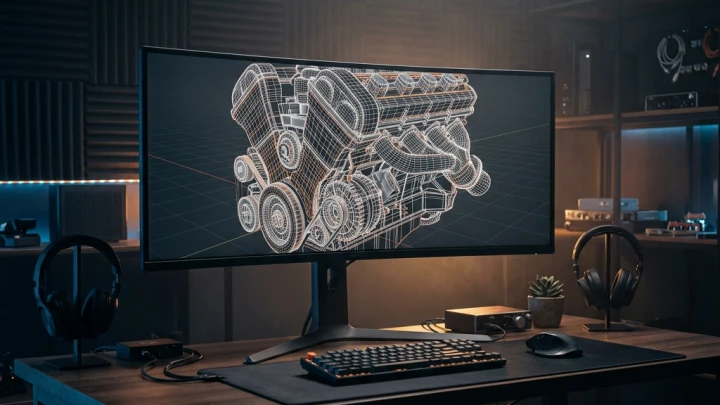
Generative geometry models have accelerated digital asset pipeline development for creators. When building characters or hard-surface accessories, developers face a significant limitation when using legacy reconstruction pipelines. Traditional systems output unstructured layouts, often called triangle soup, which require hours of manual retopology to clean. To resolve this creative bottleneck, Neural4D, jointly developed by Nanjing University, DreamTech, Oxford University, and Fudan University, implements a programmatic framework that outputs clean, structured geometry directly.
For engineers and artists, integrating automated 3D prototyping into production workflows provides a quick method to convert reference sketches into clean models. Instead of starting from scratch or wasting hours cleaning messy meshes, users upload single illustrations to generate functional 3D shapes. This transition minimizes initial modeling times, allowing development teams to spend more time on scene choreography, rigging, and dynamic lighting setups.
Algorithmic Architecture of Structured Reconstruction
Standard generators and photogrammetry programs output meshes that overload mobile browsers and game engine pipelines. The Neural4D system runs on a specialized Direct3D-S2 architecture combined with a Spatial Sparse Attention (SSA) processor. This design achieves a deterministic output that reduces structural hallucinations and mesh defects.
By focusing computational attention specifically on the coordinate zones where target surfaces reside, the engine limits cloud-processing overhead. The efficiency benefits are verified through technical parameters:
- The reconstruction pipeline processes spatial tasks approximately 12 times faster than legacy frameworks.
- A base mesh, or white model structure, is generated in about 90 seconds without PBR texture maps.
- Surface materials and texture coordinates are applied in an additional pass, outputting a complete, engine-ready GLB asset in just over 2 minutes.
Separating geometry generation from texture mapping is necessary to prevent environmental shadows from being baked into the texture files, preserving dynamic lighting compatibility.
Mesh Topology Standards and Relightable Materials
Interactive digital assets require clean topology to load efficiently inside game engines without causing lag. Standard generators often produce chaotic layouts, requiring manual retopology to make the meshes usable. Neural4D addresses this by generating clean topology with logical edge flow. The outputs feature a quad-dominant topology, simplifying skeletal rigging and asset modification.
The platform also uses a material separation model to isolate base colors from ambient shadow information. Many generators bake fixed shadows directly into the textures, rendering the models useless in dynamically lit virtual scenes. Neural4D produces a pure albedo map, ensuring that the asset is fully relightable in real-time engines. The models are generated as a watertight mesh, eliminating open holes and non-manifold geometry that would cause rendering issues during animation playback.
Community Distribution and Multimodal Interaction
The application of programmatic models extends beyond digital visualizations. For creators wishing to distribute physical promo items, watertight geometry is ready for direct manufacturing. Companies can host asset files on a 3D print community platform so fans can download and print custom merchandise. This interactive loop bridges the digital advertising space with physical brand participation.
To allow precise adjustments, the integration of Neural4D-2.5 introduces a conversational interface. Product teams can adjust parameters, material attributes, or object dimensions using text-based prompts. This feedback loop provides creators with a structured method to refine models without requiring deep technical knowledge of vertex manipulation.
Programmatic asset generation is shifting the parameters of spatial design. By combining sparse attention mechanisms with clean geometry separation, developers can bypass traditional prototyping bottlenecks and generate engine-ready assets efficiently.